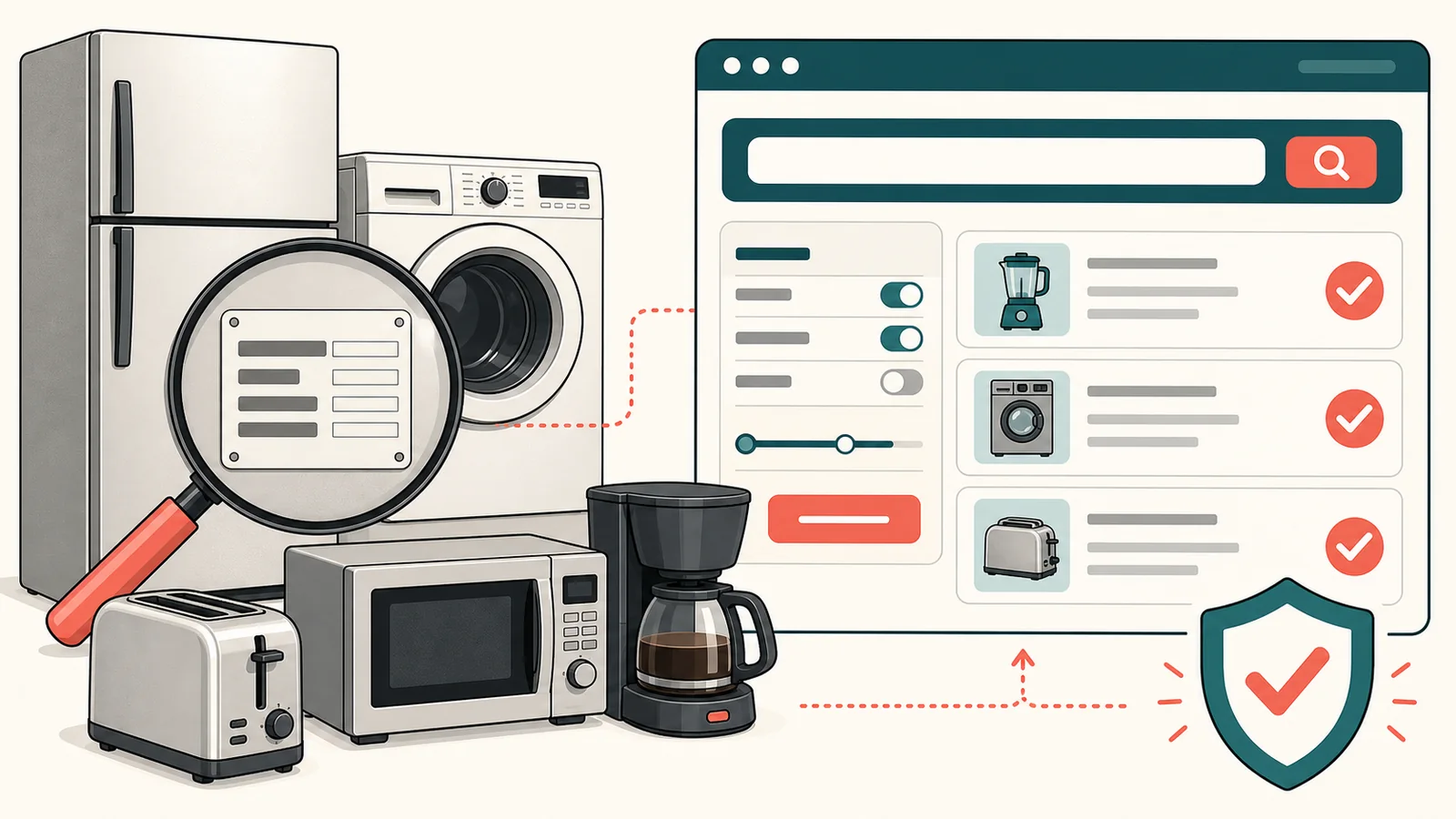
1. Record the appliance information
Photograph or write down the data plate before searching. Capture the manufacturer, full model number, serial number, and manufacturing date or code when shown. Preserve spaces, dashes, slashes, and letter case rather than guessing at a hard-to-read character.
Common locations include the refrigerator interior wall or door frame, washer or dryer door opening, dishwasher door edge, and oven door frame or lower drawer area. These locations vary. Do not tip, pull out, energize, or disassemble an appliance just to reach a label.
Keep serial numbers private. An official search may require them, but there is no reason to post a full serial number publicly or send it to an unverified social-media account.
2. Search official recall sources
- Search the CPSC recalls database using the brand and model number. CPSC provides a dedicated search field for Recalls & Product Safety Warnings.[1]
- Check the manufacturer's official recall or safety page. Use the contact information linked from the CPSC notice rather than an advertisement or sponsored search result.
- If a broad search returns nothing, try the appliance type, model family, and company search. CPSC also provides a search-by-company page.[2]
CPSC says its recall data updates weekly as new recalls are announced, while remedy information may change daily as company status or remedy availability changes.[1] Recheck the current notice instead of relying on an old screenshot.
3. Match the exact recalled range
Read the “Products,” “Description,” “Hazard,” and “Remedy” sections. Confirm every identifier the notice requires:
- Exact model or model-family number.
- Serial-number prefix, suffix, or range when specified.
- Manufacturing date, date code, retailer, configuration, or country of manufacture when specified.
- Distinguishing physical features shown in the notice.
A similar product photo or shared brand name is not enough. One size, fuel type, color, control layout, or production run may be included while another is not.
4. Follow the notice's consumer action
Some notices say to stop using the product immediately. Others give narrower instructions or permit continued use under specific conditions. Follow the current official notice rather than applying a generic rule.
CPSC says recalls usually do not have an end date, so an older appliance may still qualify. Remedies also vary: the notice may provide a repair, replacement, refund, software update, warning label, or another specific action.[4]
Use the official manufacturer phone number, website, or email listed in the notice. Keep the model/serial photo and proof of purchase when available, but do not send passwords, payment-card information, or remote-computer access credentials.
CPSC directs consumers who believe they found an unsafe product to SaferProducts.gov.[3] Reporting a concern is not the same as confirming a recall.
Avoid common recall mistakes
- Do not assume an appliance is recalled because a social post names the brand.
- Do not sell or give away a product when the official notice prohibits it.
- Do not pay an unsolicited caller before independently finding the official notice and contact channel.
- Do not confuse a service bulletin, warranty extension, settlement, or ordinary repair campaign with a CPSC recall.
- Do not rely on this site to determine eligibility. CPSC and the responsible manufacturer control the recall and remedy.
Wesley Chapel Appliance does not currently accept service requests and is not affiliated with CPSC or appliance manufacturers. Use the repair-or-replace guide only for non-recall decisions; an official recall remedy should be evaluated under the notice's own instructions.
Frequently asked questions
Where should I search for an appliance recall?
Start with the official CPSC recalls database and the manufacturer's official recall page. Avoid relying only on social posts, marketplace listings, or third-party summaries.
Is a matching brand enough to confirm a recall?
No. Match the exact model number and any serial, date, or production range in the official notice.
Should I pay someone to receive a recall remedy?
Follow the official notice and manufacturer contact information. Be cautious if an unsolicited caller requests payment, passwords, or remote access before you have verified the recall independently.
Sources
- U.S. Consumer Product Safety Commission, Recalls & Product Safety Warnings.
- U.S. Consumer Product Safety Commission, Recall Search by Company.
- SaferProducts.gov, Report an Unsafe Product.
- U.S. Consumer Product Safety Commission, Recall FAQ.