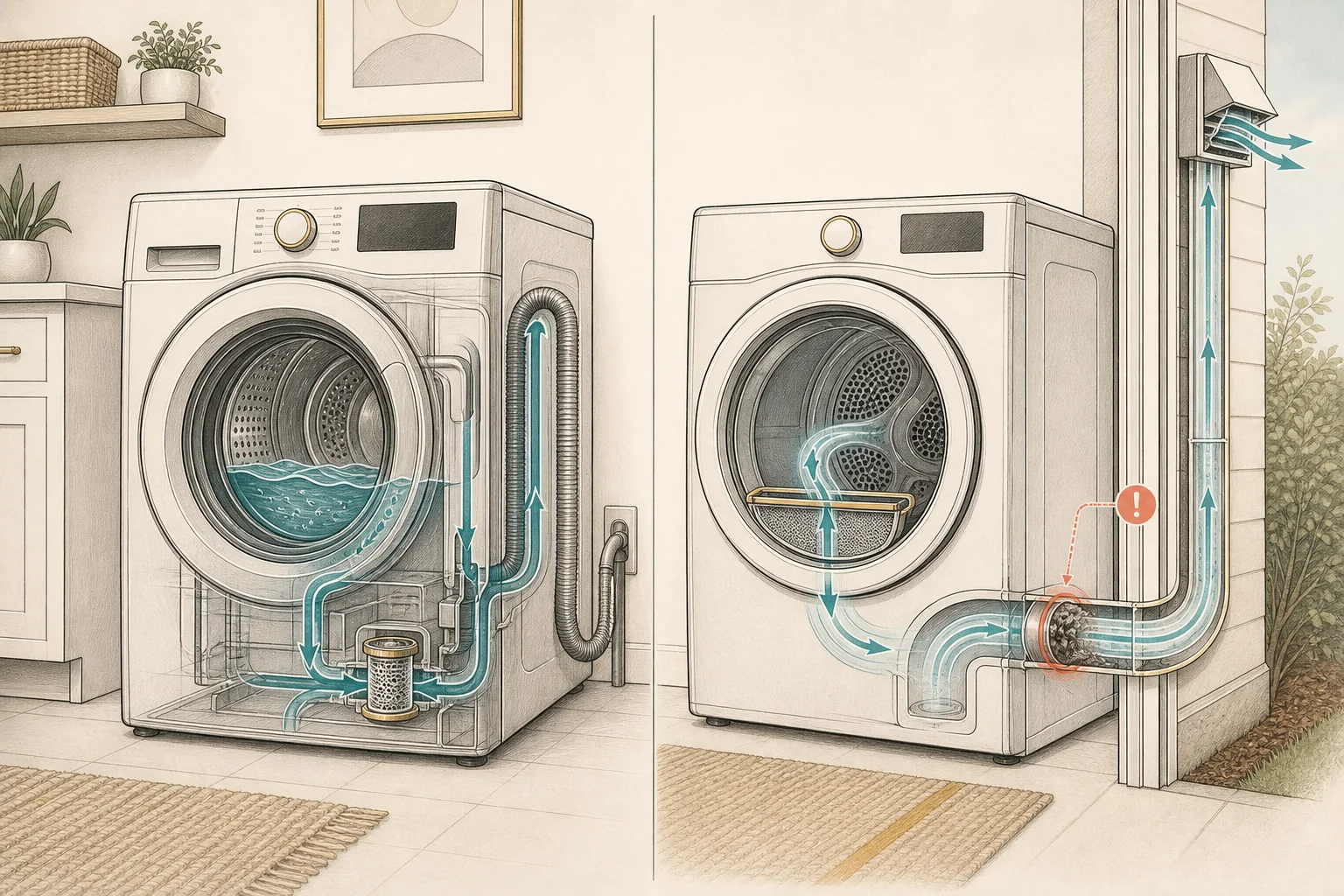
What the symptom may be telling you
Laundry appliances combine water handling, high-speed motion, heat and safety interlocks. The exact cycle stage and whether the problem affects filling, draining, turning or heating are useful clues.
- A washer that fills but does not drain differs from one that never begins the cycle.
- High-speed vibration can reflect loading, leveling, flooring, shipping hardware or mechanical wear.
- A dryer that tumbles without heat differs from a dryer that will not start or has weak airflow.
- Long drying times can be an appliance issue, an exhaust restriction or both.
Safe first checks
These observations may help distinguish a simple setup issue from a repair that needs trained diagnosis. Do not remove sealed panels, bypass safety devices, or handle refrigerant, gas, or fixed building wiring.
Rebalance safely
Pause the machine and redistribute a tangled or single-heavy-item load. Do not reach into moving equipment.
Inspect visible hoses
With water off when appropriate, look for bulges, cracks, loose visible connections or water trails. Do not loosen pressurized connections during a leak.
Check dryer airflow
Clean the lint screen and inspect the accessible exterior termination for obvious blockage. Never operate without the lint screen.
Record the cycle stage
Note whether failure occurs during fill, wash, drain, spin, tumble or heat, plus displayed error codes.
When to stop troubleshooting
- There is gas odor, scorching, smoke, repeated breaker tripping or a glowing/damaged cord.
- Water is spreading toward electrical equipment or structural cavities.
- The dryer exhaust is inaccessible, damaged inside a wall or suspected of severe buildup.
- A lid/door switch or thermal safety device would need to be bypassed.
Information to gather before contacting a provider
Clear details help a provider determine whether the appliance and problem fit its capabilities.
- Model/serial, gas or electric dryer, and stacked/built-in configuration.
- Exact cycle and stage where the problem appears.
- Error code, unusual noise and whether the drum/tub moves by hand only when safely powered off.
- Age and history of leaks, vent cleaning, moving or installation changes.
Ready to bring in a professional?
Wesley Chapel Appliance is not yet routing service requests. Use the checklist above when you contact a provider — it is the fastest way to avoid a mismatched visit.
This website is an independent information and referral site, not a repair contractor. When referrals launch it may be paid a referral fee, and that will be disclosed here.
Frequently asked questions
Is a dryer with no heat always a bad heating element?
No. Power supply, airflow, controls, sensors, gas ignition components and safety devices may cause similar symptoms.
Why does a washer shake only with towels or bedding?
Heavy absorbent items can become unbalanced. Persistent movement with balanced loads can indicate leveling, floor or mechanical issues.
Can I run the dryer if it smells hot?
Stop operation if there is a burning or abnormal hot odor. Lint, airflow and electrical problems can create fire risk.
Does this site book laundry-appliance repair?
No. The site currently provides information and is evaluating independent referral partners.
Water-related context: Hard water and washer residue explains what mineral residue can—and cannot—show about an appliance symptom.