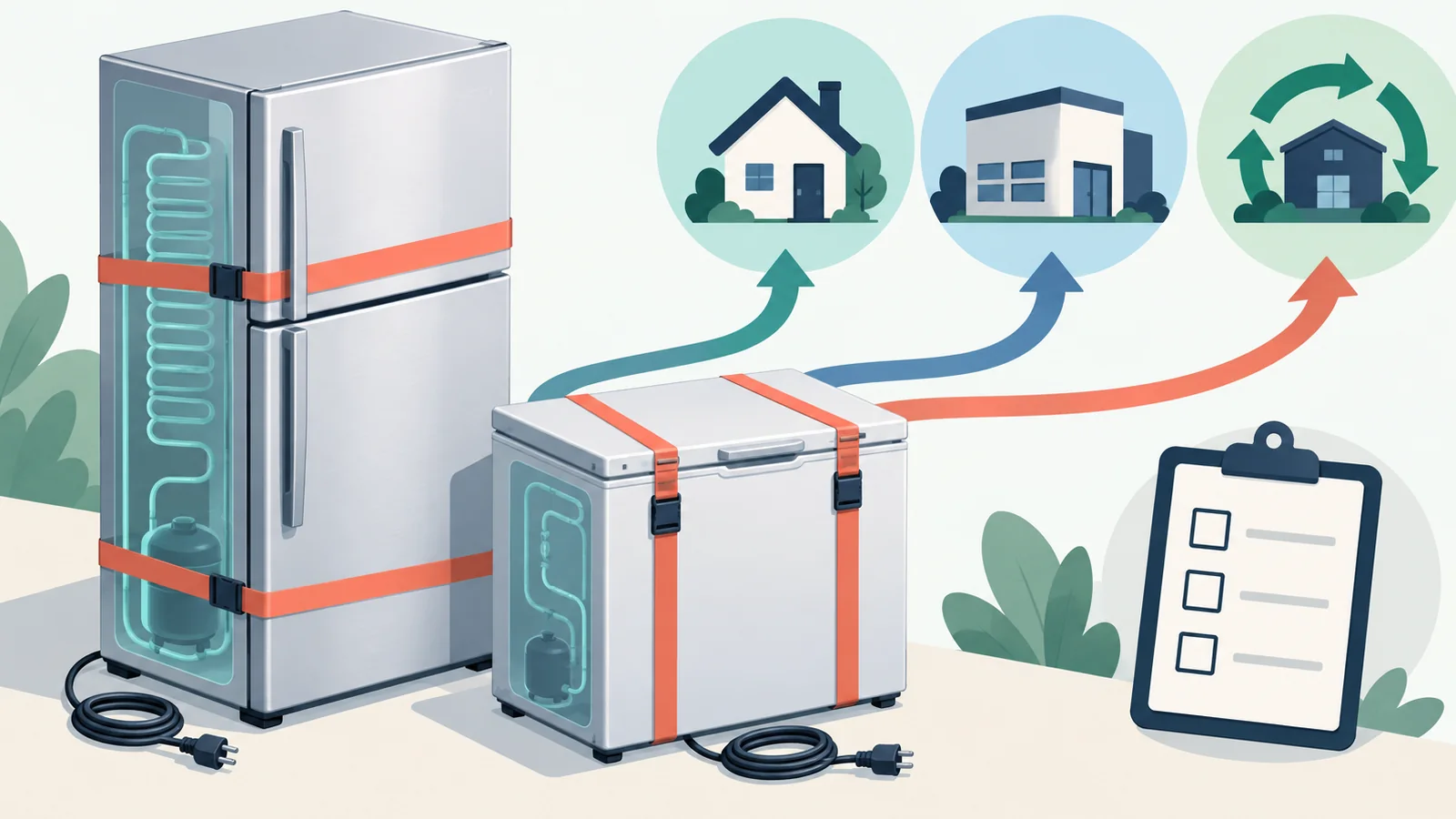
Why refrigerators and freezers need special handling
Refrigerated appliances can contain refrigerant, compressor oil, insulation-foam blowing agents, and, in some older units, mercury or PCBs. Refrigerants vary with age and design: appliances have used CFCs, HCFCs, HFCs, and newer non-fluorinated refrigerants such as R-290 propane.[1] Do not call every refrigerant “Freon” or assume every old unit contains an ozone-depleting refrigerant, mercury, or PCBs.
Federal requirements govern refrigerant recovery and certain hazardous components. Foam recovery is not federally required, so “recycled” does not guarantee that every material or foam blowing agent was recovered.[1]
Choose a disposal channel
Retailer haul-away
When delivering a replacement, some retailers may collect the old refrigerator or freezer. Programs can be purchase-dependent, and terms and charges vary. Ask whether the appliance will be recycled or resold and whether foam recovery is included.[1][3][4]
Utility or state energy program
EPA advises checking with the electric utility for a rebate, bounty, or turn-in program. ENERGY STAR also points consumers to state energy offices, utilities, and energy-efficiency organizations. Working condition, age, size, account, and other eligibility rules may apply.[1][4]
Municipal collection or drop-off
A municipality may offer scheduled bulky-item collection, require an appointment, direct residents to a transfer station or landfill, or use a solid-waste contractor. Some require refrigerant recovery before acceptance; verify current local rules rather than assuming curbside collection is available.[1] For local information, see the Pasco County appliance disposal guide.
Scrap-metal recycler
ENERGY STAR lists local scrap-metal recyclers as another option and advises asking for assurance that the appliance will be properly recycled.[4] Verify that a qualified recycler accepts an intact refrigerant-containing appliance and follows a compliant refrigerant-recovery process.
Confirm details before moving the appliance
- Does the program accept refrigerators and stand-alone freezers, and must the unit work?
- Do account, address, purchase, size, or age restrictions apply?
- Is collection offered, or is self-haul required? Is an appointment required?
- Is there a charge, rebate, voucher, or bill credit?
- Who handles refrigerant recovery, and does the recycler also recover insulation foam?
- Will the unit be permanently retired or potentially resold?
- What preparation and access instructions apply?
EPA and ENERGY STAR describe possible channels but do not establish one national price, collection policy, preparation protocol, or availability promise.[1][4]
Leave the sealed system intact
For household refrigerators and freezers entering the waste stream intact, the final person in the disposal chain, such as a scrap processor or landfill owner, is responsible for ensuring refrigerant recovery before final disposal.[2] EPA does not say that final-disposal recovery from every small appliance always requires a Section 608-certified technician; it does require qualifying recovery equipment and a compliant process. Consumers should not attempt recovery themselves and should follow the receiving program’s approved process.[1][2]
Understand what “recycling” may mean
EPA says collected appliances may be resold, recycled, or landfilled. Typical recycling can include refrigerant recovery, removal of hazardous components, shredding, and metal separation, while glass, plastic, and foam may still be landfilled.[1] ENERGY STAR notes that some programs capture insulation foam, making it a practice to ask about rather than an assumed service.[4]
EPA’s current page describes the Responsible Appliance Disposal (RAD) Program as program history for 2006–2025 and describes its partners in the past tense.[1] Wesley Chapel Appliance is not a RAD partner and does not represent that the historical program is currently active.
Final handoff checklist
- Identify the appliance as a refrigerator or stand-alone freezer.
- Compare retailer, utility, municipal, and scrap-recycler options.
- Verify current acceptance, eligibility, cost, scheduling, and preparation instructions directly.
- Leave refrigerant lines and the compressor intact.
- Follow only the receiving program’s instructions for collection or self-haul.
- Ask how refrigerant and regulated components are handled and whether foam is recovered.
- Do not leave the unit at the curb unless an authorized collection has been scheduled; EPA warns that unscheduled curbside appliances may be handled unsafely.[1]
Frequently asked questions
Can I put an old refrigerator out with regular trash?
Do not assume so. Municipal procedures vary. Confirm current local requirements before placing an appliance at the curb.[1]
Will a retailer remove my old refrigerator?
Some retailers offer haul-away with a replacement purchase, but availability, charges, and purchase requirements vary.[1][3][4]
Will my electric utility pay me to recycle a refrigerator?
Some programs offer rebates, cash incentives, or bill credits, with eligibility rules that vary. Check directly with the utility.[1][4]
Can I remove the refrigerant myself?
No. Do not cut refrigerant lines, remove the compressor, or tamper with the sealed system. Use the receiving program’s process.[2][3]
Does every refrigerator recycler recover the insulation foam?
No. EPA says foam treatment is not federally required, while ENERGY STAR says some programs capture insulation foam.[1][4]
Does a refrigerator need an EPA sticker before disposal?
EPA does not mandate or accept a sticker as proof of refrigerant recovery. The final disposer follows EPA documentation or contractual verification rules.[1][2]
What happens after a refrigerator is collected?
EPA says it may be resold, recycled, or landfilled. Recycling does not necessarily recover every material.[1]
Sources
- U.S. Environmental Protection Agency, Appliance Disposal.
- U.S. Environmental Protection Agency, Stationary Refrigeration Safe Disposal Requirements.
- U.S. Environmental Protection Agency, Homeowners and Consumers: Frequently Asked Questions.
- ENERGY STAR, Find a Fridge or Freezer Recycling Program.