How to Prevent Dryer Fires without assuming one cause
Lint can accumulate in the dryer or exhaust duct, restrict airflow, and contribute to excessive heat and fire risk.[3] The U.S. Fire Administration reports that failure to clean was the leading factor contributing to ignition in 31% of home clothes-dryer fires during 2018–2020.[1]
The National Fire Protection Association separately estimated an annual average of 13,820 home structure fires involving dryers in ignition during 2014–2018. Failure to clean was a factor in 32%; mechanical failure or malfunction was a factor in 27%, and electrical failure or malfunction in 16%.[5] Lint is not the only possible contributor, and preventive maintenance cannot diagnose a symptom or guarantee safety.
Every load: filter and safe-use habits
- Use the dryer only with its lint filter installed, and clean the filter before or after every load. USFA uses the conservative wording “before and after each cycle.”[2]
- Remove lint only from places intended for routine user access. Do not open the dryer cabinet or reach near wiring, burners, motors, or moving parts.
- For each load, follow the manufacturer’s load, care, and operating instructions; do not overload the dryer.
- Turn the dryer off before leaving home or going to bed.[7]
Check the visible airflow path
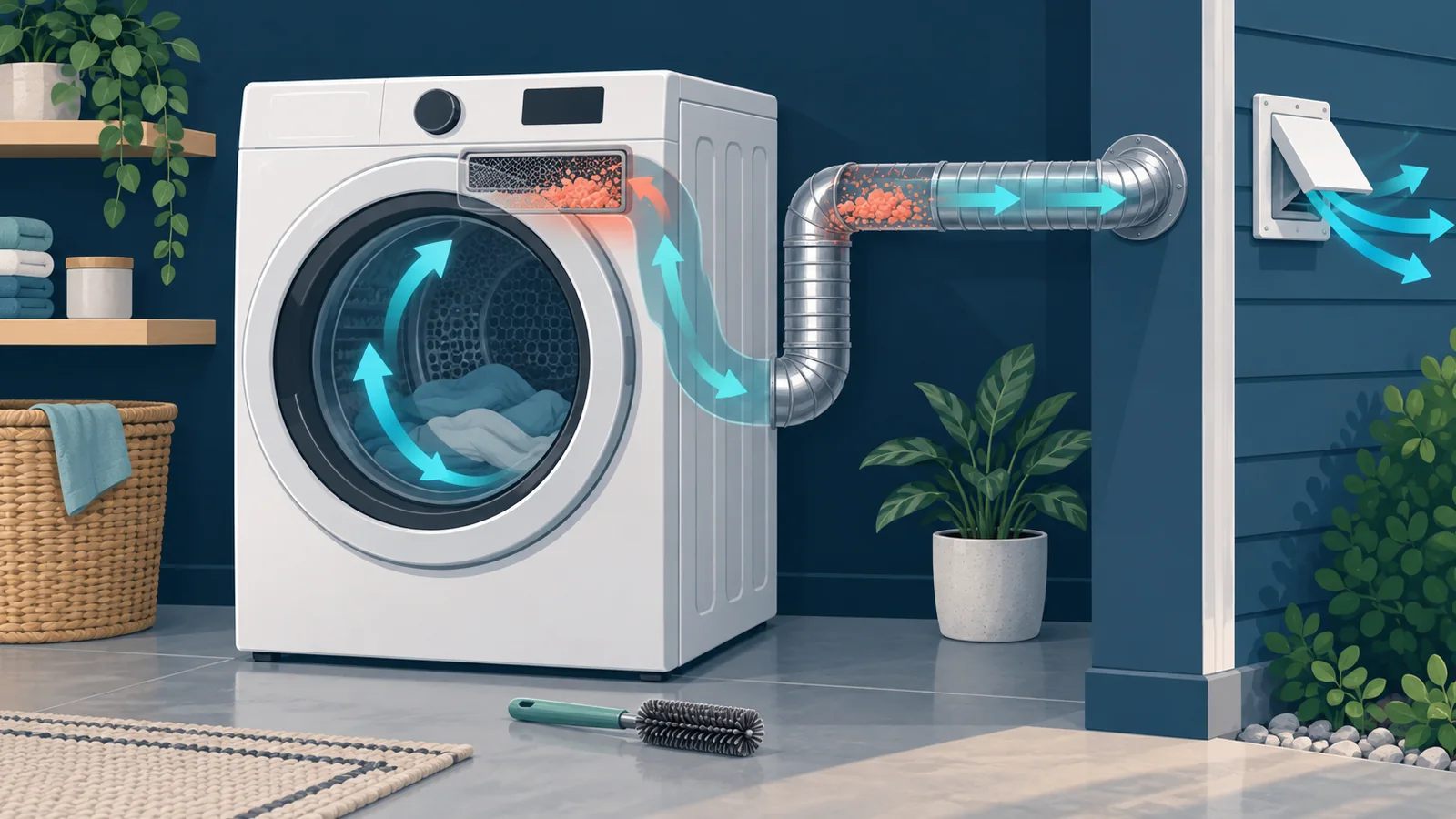
Keep the area around and behind the dryer free of lint and combustible storage such as boxes, cleaning supplies, and clothing.[2][7] Without moving or dismantling the appliance, look for accessible transition ducting that is crushed, kinked, or visibly damaged. During otherwise normal operation, observe from outside whether the exterior vent flap opens.
A flap that does not open, weak exhaust, or loads taking longer than normal can indicate restricted airflow, but none identifies its location or cause.[2][3] The U.S. Consumer Product Safety Commission advises periodic exhaust-duct cleaning. NFPA gives once a year, or more often when drying begins taking longer, as a public benchmark; pair it with the dryer and vent-system manufacturer’s instructions.[3][7]
Do not push brushes through concealed ducts, disconnect ducts or gas fittings, touch damaged electrical connections, or pull out a heavy dryer. Refer inaccessible, complex, long, or shared exhaust systems to a qualified provider. Ventless and heat-pump dryers need model-specific filter, condenser, or heat-exchanger care; the exterior-vent checklist does not apply to them.
Venting, outlet, and hazardous-load precautions
CPSC advises replacing plastic or foil accordion-style ducting with rigid or corrugated semi-rigid metal duct because plastic and foil can trap lint and are more susceptible to kinking or crushing.[3] Use venting specified by the dryer manufacturer and applicable installation requirements. Have uncertain, damaged, or inaccessible venting corrected professionally.
USFA says major appliances, including dryers, should plug directly into a wall outlet and should not use an extension cord.[1] Do not attempt receptacle, breaker, cord, grounding, or gas-line work yourself.
Do not put clothing that still carries gasoline, paint thinner, or similar flammable solvents directly into the dryer. Follow the chemical warning, garment-care label, and appliance manual rather than treating a low-heat cycle as a universal solution for chemical, cooking-oil, foam, rubber, or plastic contamination.[7]
When prevention requires professional help
USFA and NFPA recommend professional installation and service.[2][7] Qualified help is appropriate for internal chassis cleaning; damaged, inaccessible, or uncertain venting; repeated airflow or drying-time problems; gas-dryer inspection; electrical damage or recurring breaker trips; and any concern that the dryer is not operating safely. This guide does not teach internal, electrical, or gas repair.
Recurring dryer safety checklist
Every load: keep the lint filter installed and cleaned; confirm the load is permitted by care labels and the manual; and do not run the dryer while the home is empty or occupants are asleep.
Periodically: clear accessible lint and combustible storage, visually inspect accessible venting, confirm the outdoor flap opens during otherwise normal operation, and arrange vent cleaning on the manufacturer’s schedule using NFPA’s annual benchmark where applicable.[2][3][7]
Stop and switch guides: smoke, flame, a burning or electrical odor, scorching, unusual heat, sparks, repeated breaker trips, gas odor, or recurring performance warnings are not routine prevention tasks. Use the burning-odor safety guide or emergency guidance instead.
Frequently asked questions
How often should I clean the dryer lint filter?
Clean it before or after every load. USFA recommends cleaning it before and after each cycle. Never operate the dryer without its filter installed.[2]
How often should a dryer vent be cleaned?
CPSC says periodically; NFPA gives once a year, or more often when drying begins taking longer, as a public benchmark. Follow the appliance and vent-system manufacturer’s instructions.[3][7]
Does longer drying time prove the vent is clogged?
No. It may indicate a blocked lint screen or exhaust duct, but it is a warning that warrants checking or qualified evaluation—not proof of a specific blockage.[3]
Can a dryer fire happen even if I clean the lint screen?
Yes. Cleaning matters, but mechanical and electrical failures or malfunctions are also contributing factors. Installation, venting, loading, and qualified service still matter.[5]
Is flexible foil dryer duct safe?
CPSC advises replacing plastic or foil accordion-style ducting with rigid or corrugated semi-rigid metal duct. Have uncertain venting evaluated.[3]
Sources
- U.S. Fire Administration, Appliance and Electrical Fire Safety.
- U.S. Fire Administration, Clothes Dryer Fire Safety.
- U.S. Consumer Product Safety Commission, Overheated Clothes Dryers Can Cause Fires.
- National Fire Protection Association, Home Fires Involving Clothes Dryers and Washing Machines.
- National Fire Protection Association, Home Fires Involving Clothes Dryers and Washing Machines (2017).
- National Fire Protection Association, Clothes Dryer Safety.
- U.S. Fire Administration, Home Fire Escape Plans.