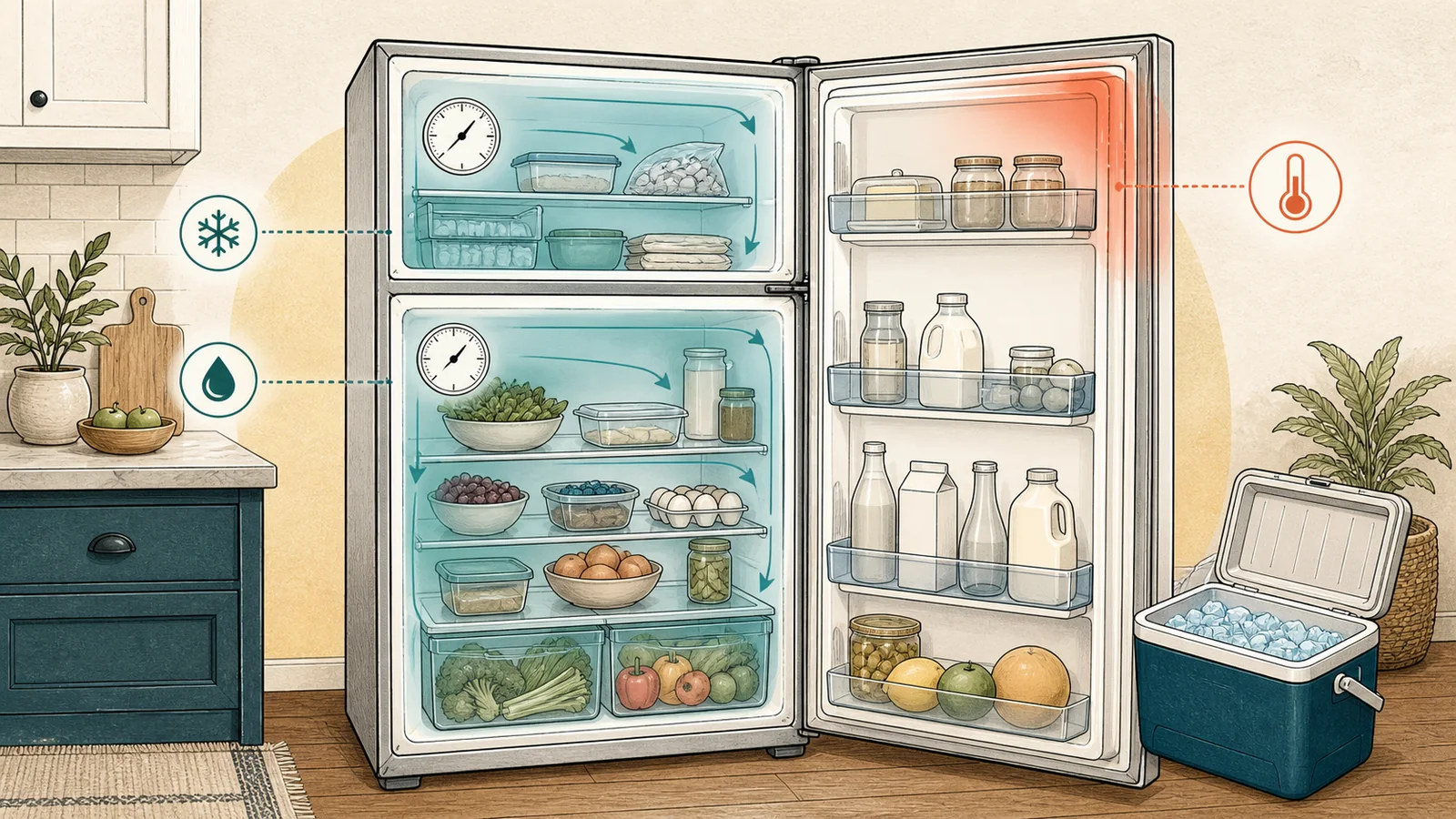
Start with measured temperature
Do not rely on how cold a container feels or where the control knob is set. Place an appliance thermometer near the center of each compartment and minimize door openings. A separate food thermometer can help check an individual item.
FDA recommends keeping the refrigerator at 40°F or below and the freezer at 0°F. FDA also notes that few refrigerator controls show the actual compartment temperature, which is why a freestanding appliance thermometer is useful.[1]
A practical food-safety decision table
| What you know | Conservative next step |
|---|---|
| Refrigerator is 40°F or below | Keep the door closed, monitor the thermometer, and protect food while you investigate the cooling problem. |
| Perishable food was above 40°F for two hours or less | FDA says it should generally be safe, but use food-specific guidance and move it back below 40°F promptly.[1] |
| Perishable food was above 40°F for more than two hours, or the time is unknown | Discard it rather than tasting it. FDA advises throwing food out when you are unsure how long it was at or above 40°F.[1] |
| Power outage with the refrigerator unopened | An unopened refrigerator keeps food cold for about four hours, according to FDA and USDA. This is an estimate, not a substitute for temperature readings.[2][3] |
| Frozen food still has ice crystals or measures 40°F or below | FDA says it can generally be refrozen or cooked, although quality may change.[1] |
The outage estimate and the time-above-40°F rule answer different questions. The four-hour figure describes how long a closed refrigerator may hold temperature without power. It does not guarantee that every item stayed safe. Use the measured temperature and food-specific charts.
A closed, full freezer generally holds temperature for about 48 hours; a half-full freezer for about 24 hours.[3] Cooking is not a dependable way to rescue inadequately refrigerated perishables, because some food-safety hazards can remain even after thorough cooking.[4]
Safe cooling checks after food is protected
- Confirm the refrigerator has power and the interior light or display behaves normally.
- Check that doors close fully and packages are not holding a door open.
- Look for blocked interior vents and heavy frost without removing panels.
- Note whether the freezer is also warming, whether fans sound different, and whether a recent outage or control change occurred.
- Keep the model number, approximate age, measured temperatures, and timing together for any later diagnosis.
Do not chip ice with a sharp tool, remove sealed panels, test live wiring, or handle refrigerant. Cooling complaints can involve airflow, controls, fans, defrost systems, heat rejection, or the sealed refrigeration system. One symptom does not prove one failed component.
When in doubt, protect people rather than the groceries
Do not taste food to decide whether it is safe. Odor and appearance are not reliable safety tests. People who are pregnant, older, very young, or immunocompromised can face higher risk from foodborne illness, so conservative decisions matter.
For item-specific decisions, use the current FDA or USDA charts rather than a generalized blog list. If the failure followed a storm or outage, note the time power was lost and restored. If it was mechanical, record the first confirmed warm reading and any earlier normal reading.
Wesley Chapel Appliance does not currently accept service requests. The refrigerator symptom guide explains cooling observations, while the repair-or-replace guide helps after a real diagnosis exists.
Frequently asked questions
Should a refrigerator stay at 40°F or below?
Yes. FDA recommends 40°F or below for the refrigerator and 0°F for the freezer. Use an appliance thermometer because a numbered control setting does not show the actual temperature.
Is food safe after four hours in a warm refrigerator?
The four-hour estimate applies to an unopened refrigerator during a power outage. What matters is the food's measured temperature and time above 40°F. Follow FDA or USDA food-specific guidance and discard when time is unknown.
Can smell or appearance prove refrigerated food is safe?
No. Food can be unsafe without an unusual smell or appearance. Do not taste food to test safety.
Sources
- U.S. Food and Drug Administration, “Refrigerator Thermometers: Cold Facts about Food Safety”.
- U.S. Food and Drug Administration, “Power Outages: Key Tips for Consumers About Food Safety”.
- USDA Food Safety and Inspection Service, “Keep Your Food Safe During Emergencies”.
- U.S. Food and Drug Administration, “Food and Water Safety During Power Outages and Floods”.